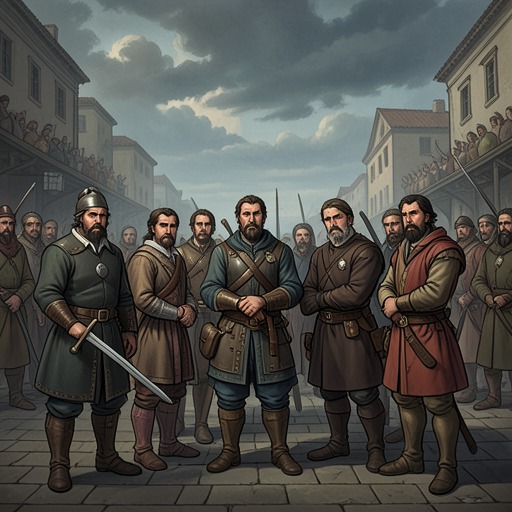
Gentlemanly honor
The Three MusketeersGentlemanly honor is the moral code that directs d'Artagnan the younger from his departure for Paris through his first victories and friendships. It joins inherited noble identity to visible courage: a gentleman must sustain his name, answer affronts, accept danger, keep faith with companions, and recognize valor even when it appears in an opponent. Yet the code exists under political constraint. Duels are forbidden, while the culture surrounding honor treats readiness to fight as proof of character, making personal dignity both an ethical obligation and a continual invitation to conflict.
Inheritance and Definition
M. d'Artagnan the elder gives the code its earliest and most explicit formulation. His son is told to sustain worthily the name of a gentleman, a name borne by his ancestors for five hundred years, for his own sake and for the sake of his relatives and friends. Honor therefore exceeds private pride: conduct reflects upon a family and upon the people bound to the gentleman by affection and loyalty. The father's advice also places courage at the center of social advancement. In his account, a gentleman must endure nothing from anyone except Monsieur the Cardinal and the king, and must seize the brief opportunity that fortune offers rather than hesitate until it disappears.
The advice is inseparable from Gascon identity and filial duty. The elder d'Artagnan tells his son that he must be brave for two reasons, because he is a Gascon and because he is his son. He supplies fifteen crowns, a family horse, a healing balsam, and a set of principles rather than material security. The old Bearn pony, yellow-skinned, tailless, afflicted with windgalls, and capable of eight leagues a day, becomes part of this inheritance: it is not to be sold, but cared for like an old servant. The instruction makes loyalty to the apparently ridiculous animal a small but concrete rehearsal of the larger obligation to honor origins, service, and inherited trust.
The elder presents M. de Treville as the practical model of this ethic. Though dueling is constrained by edicts, ordinances, and decrees, M. de Treville has fought repeatedly and risen to become captain of the Musketeers, a commander esteemed by Louis XIII and feared by Cardinal Richelieu. His success demonstrates the tension at the heart of the code: official authority condemns private combat, but aristocratic society continues to reward the courage and reputation produced by it. For d'Artagnan, honor is thus not merely a sermon from home; it is a proposed route into the world.
Honor as Promise and Self-Presentation
At M. de Treville's hôtel, d'Artagnan treats his future reputation as something he must actively create. When offered a letter of recommendation for the director of the Academy, he accepts it but vows to guard it carefully and warns that anyone attempting to take it will regret the attempt. The flourish is youthful, but it reveals the form honor takes in him: a promise is made publicly, danger is acknowledged, and the self is defined through the readiness to defend what has been entrusted to it.
His manner combines bravado with courtesy. D'Artagnan imagines the future as lying in his own hands, yet his claims are not presented as mere aggression. The letter matters because it is a sign of trust from M. de Treville, and protecting it is an extension of protecting his word. The episode also shows how gentlemanly honor is performed before witnesses. Reputation is not an invisible inward virtue; it is established through gestures, declarations, posture, and the capacity to turn words into action.
The Duel and the Creation of Fellowship
The code reaches its first decisive test when d'Artagnan offers Athos a place in his service while Athos is wounded and the proposed duel has been delayed. D'Artagnan says that the balsam would cure Athos in less than three days and that, once Athos had recovered, it would still be an honor to serve as his man. The offer is made simply and courteously, without diminishing his courage. It is simultaneously an act of service, a recognition of Athos's rank, and a promise that the present conflict need not destroy the possibility of future allegiance.
Athos recognizes the proposal as the speech and conduct of a gentleman. He compares its spirit with the gallant knights of the time of Charlemagne, while observing that the current age is ruled by the cardinal rather than by the great emperor. The political reality makes the old ideal difficult to practice: a secret duel would probably become known and be prevented. Honor survives, but it must negotiate surveillance, command, and the prohibition of private combat. D'Artagnan's willingness to postpone violence without surrendering dignity shows that the code can include restraint as well as attack.
The later confrontation with the Cardinal's Guards reveals the collective side of honor. When Bicarat is ordered to withdraw because the Musketeers outnumber his side, he obeys his commander, breaks his sword across his knee rather than surrender it, throws the pieces over the convent wall, and stands whistling a cardinalist air. The Musketeers salute him with their swords because bravery is respected even in an enemy. They then help carry the wounded Jussac, Cahusac, and one of Aramis's adversaries beneath the convent porch, while the fourth opponent is dead. Honor here does not erase factional conflict, but it places a limit upon contempt: an enemy may be politically opposed and still be acknowledged as courageous.
Consequences and Limits
The same code that makes recognition possible also turns the young man's arrival into a chain of dangerous confrontations. D'Artagnan's readiness to seek adventures, fight when challenged, and answer insults is the means by which he proves himself, but it also exposes him to injury, legal prohibition, and the risk that personal reputation will override prudence. His father's injunction to fight more because duels are forbidden captures the paradox exactly: prohibition increases the prestige of defiance, so the law designed to suppress violence can make courage appear more valuable when expressed through violence.
After the convent encounter, the ethical value of the code is measured by its social result. D'Artagnan and the Musketeers return carrying four swords out of five, and their march through the streets becomes a triumphal procession. D'Artagnan walks between Athos and Porthos, pressing them tenderly, and asks whether, though he is not yet a Musketeer, he has at least begun his apprenticeship. His new standing arises not from formal admission but from shared danger, mutual aid, and the public recognition of courage. Honor has converted strangers who intended to duel into companions who occupy the street arm in arm.
Narrative Significance
Gentlemanly honor supplies the novel's bridge between private identity and public action. D'Artagnan begins with a family name, a poor inheritance, an ungainly horse, and paternal instructions; he gains belonging by making those instructions visible in encounters with M. de Treville, Athos, Porthos, Aramis, and the Cardinal's Guards. The code is therefore developmental: it gives him a language for entering aristocratic society and a standard by which others can judge him.
Its deepest force lies in the contrast between principle and institution. The king, the cardinal, military commands, and anti-dueling decrees regulate behavior from above, while gentlemanly honor demands immediate personal action below. The Musketeers' salute to Bicarat shows that the code can interrupt political hatred with respect; the triumphal return shows that it can generate loyalty; the repeated pressure toward combat shows its cost. Honor is neither simple legality nor unrestrained pride. It is a volatile virtue whose promise of dignity and fellowship is realized through the very danger that makes it difficult to govern.